
Most drivers spend years thinking about what happens inside the car during a crash. Airbags, crumple zones, seatbelt pretensioners. Far fewer think about the hardware sitting on the shoulder that decides how the crash starts in the first place.
Roadway departure crashes, the ones where a vehicle leaves its travel lane and heads off the pavement, account for a disproportionate share of serious injuries and deaths on American roads. What your car hits after that moment matters enormously. Research on real-world crash data found that hitting a guardrail reduces the probability of a fatal or severe injury by roughly 45 to 50 percent compared to the alternatives waiting off the road. An Indiana study of more than 2,000 single-vehicle crashes put numbers on the individual systems: the odds of injury dropped 39 percent for a median concrete barrier wall, 65 percent for a guardrail face, and 85 percent for a near-side median cable barrier.
Those are not small differences. They are the difference between three types of hardware that look, to a driver at 70 mph, like roughly the same thing. Here is what each one actually does to your vehicle, and why engineers pick one over another.
The Basic Idea – Trade a Bad Crash for a Survivable One
Every piece of roadside safety hardware is built on the same principle. Nothing on the shoulder is safe to hit. The barrier exists because whatever is behind it is worse.
A bridge pier, a steep embankment, a stand of mature trees, a drop into oncoming traffic. Compared to any of those, a controlled impact with a metal rail is a bargain. Engineers call this the clear zone concept: give the errant vehicle a recoverable area beside the road, and where you cannot, put something there that manages the crash instead of ending it.
That management comes down to two things: how much energy the system absorbs, and where it sends your vehicle afterward. A good barrier slows you down over distance and keeps you moving roughly parallel to traffic. A bad outcome is one that stops you instantly, launches you, or spins you back into the travel lane.
Cable Barriers – The Ones That Look Too Flimsy to Work
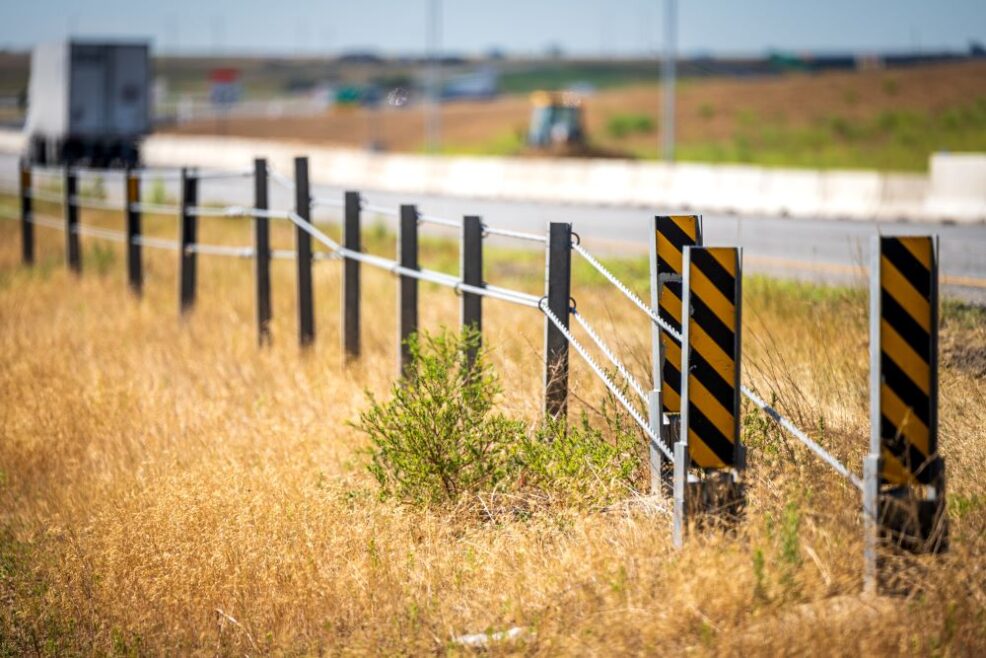
Drive any modern interstate and you will see them in the median. Three or four tensioned steel cables strung between posts that look like they would fold under a bicycle.
The posts are supposed to fold. That is the entire design.
How They Work
High-tension cable barrier consists of pre-stretched steel wire ropes anchored at the ends and held at height by breakaway line posts. When a vehicle strikes it, the posts release and the cables catch the car, stretching and absorbing energy over a long distance. Your vehicle decelerates gradually rather than slamming into something rigid.
That long deflection distance is why cable barriers post the best injury numbers of any barrier type. The tradeoff is that they need room. A cable barrier can deflect eight to twelve feet on impact, so it only works in medians wide enough to allow that movement without pushing the vehicle into opposing traffic.
What They Solve
Cross-median crashes are among the most severe events that happen on divided highways. A vehicle crosses the grass and meets oncoming traffic head-on, where impact forces combine both vehicles’ speeds. State transportation departments that installed median cable barriers widely report drops in cross-median fatalities of 90 percent or more.
The visible downside is maintenance. Cable barriers get hit often and need repair crews out frequently. Agencies accept that cost because the repair bill is trivial next to the crash outcomes being prevented.
Guardrail – The Middle Ground
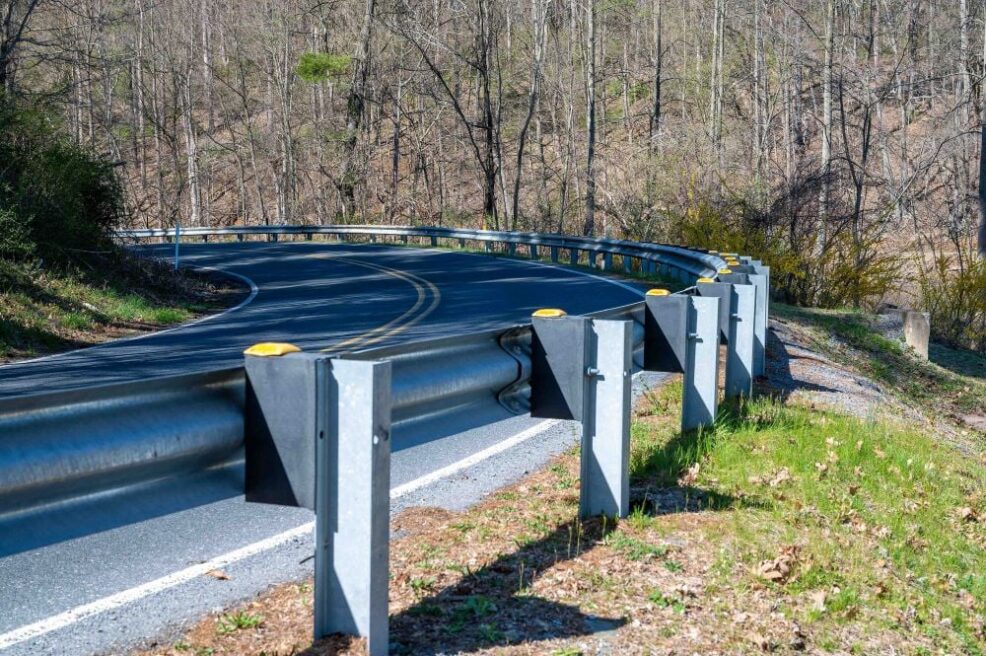
W-beam guardrail, the corrugated steel you see on shoulders and around curves, is the compromise between cable and concrete. It deflects less than cable, roughly two to four feet, and redirects the vehicle back toward the roadway rather than catching it.
The corrugation is structural. That wave shape gives the beam bending stiffness while still allowing it to deform and absorb energy on impact. Posts are spaced to fail progressively, so the system yields in a controlled sequence instead of all at once.
The End Terminal Question
If you remember one thing from this article, make it this: the dangerous part of a guardrail is the end.
An unshielded guardrail end is a spear pointed at oncoming traffic. Hit the face of a guardrail and it works as designed. Hit a blunt, unprotected end head-on and the beam can penetrate the passenger compartment. This is why modern installations use energy-absorbing end terminals, which are the boxy assemblies at the start of a rail run that ratchet, extrude, or slide the beam sideways as the vehicle pushes into them.
Older highways still have legacy end treatments. Some are turned down into the ground, which can act as a ramp. Ongoing federal and state programs continue replacing them, but they have not all been retired.
Concrete Barrier – Maximum Containment, Minimum Forgiveness
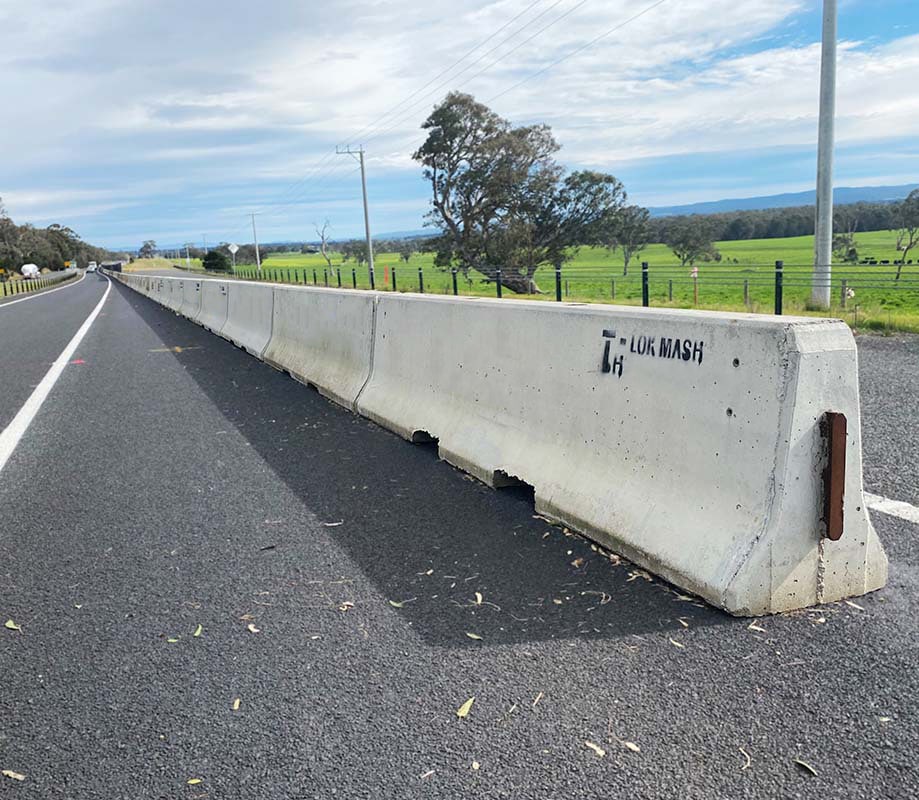
The concrete shapes in narrow medians and construction zones, usually the F-shape or the older New Jersey profile, are rigid systems. They deflect almost nothing.
Look at the profile and you will see the logic. The lower section angles outward at the base, so a tire riding into it climbs slightly, lifting the vehicle and helping it slide along the wall rather than digging in and rolling. The upper section is nearly vertical to prevent the vehicle from riding up and over.
Concrete gets used where deflection is not an option. Narrow medians, bridge parapets, protecting workers or pedestrians on the other side. It contains almost anything, including heavy trucks, which cable barrier often cannot. The price is that occupants absorb more of the crash energy, which is exactly what the injury data shows.
Temporary versions, the interlocking sections you see beside construction zones, follow the same principle in movable form. Agencies and contractors select from the same family of traffic barriers whether the installation is permanent or lasts six weeks, choosing between concrete, water-filled plastic, and steel systems based on the site’s speed, available deflection room, and how quickly the setup needs to move. That last factor drives more decisions than drivers realize. A barrier that has to be repositioned nightly cannot be a permanent concrete pour.
Crash Cushions – The Yellow Drums That Save Lives
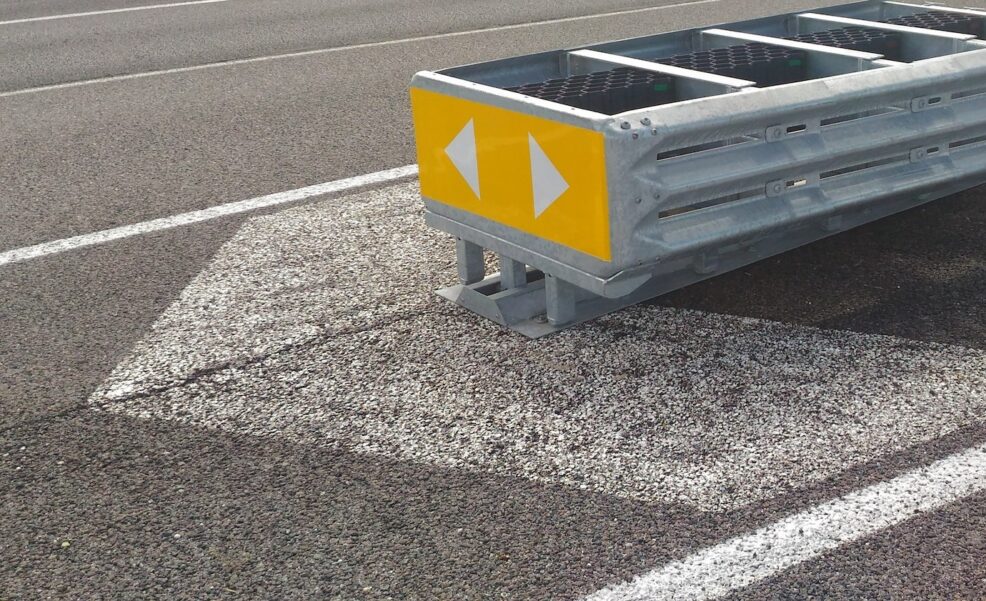
That cluster of yellow barrels in front of a bridge pier or at a highway exit gore point is not decoration and it is not sand storage in the casual sense. It is an impact attenuator, and it is doing precise physics.
Sand-filled barrel arrays work by momentum transfer. The barrels are arranged with progressively heavier fill, lightest at the front. Your vehicle scatters the light ones first, then the heavier, and each collision transfers momentum from your car to a mass of sand. You decelerate in stages instead of hitting a fixed object at full speed.
Other systems do the same job differently. Compressive attenuators use crushable cartridges or telescoping frames that collapse over a defined distance. Truck-mounted attenuators, the folded steel assemblies on the back of highway maintenance trucks, protect both the work crew and the driver who fails to notice a stopped vehicle.
The reason these appear at gore points, those wedge-shaped splits where an exit ramp separates from the mainline, is that the gore is where confused drivers make late decisions. Give someone a rigid barrier end at that spot and you have built a hazard. Give them an attenuator and you have built a bad day instead of a fatality.
What This Means for You as a Driver
A few things follow from all of this that actually change how you should drive.
- Do not swerve to avoid a barrier. Drivers who leave the road often overcorrect and end up crossing the median or rolling. A barrier strike is a designed outcome. A rollover is not.
- Give barrier-lined sections more room. Narrow shoulders beside concrete walls leave no recovery space. Increase following distance where the barrier sits close to the lane.
- Report barrier damage. Damaged guardrail and disconnected cable barrier stay broken until someone tells the DOT. Many crashes go unreported for infrastructure purposes, which means the next driver hits a system that no longer works.
- Treat work zone barriers as permanent objects. Temporary does not mean lightweight. A water-filled or concrete unit will not move for your vehicle.
Why Your Insurance Company Cares About This Too
Hitting roadside hardware is a collision claim, not comprehensive. That distinction matters for your deductible.
More surprising to most drivers: state transportation agencies routinely bill at-fault drivers for barrier repair. Guardrail replacement runs into thousands of dollars, and end terminals cost considerably more than a plain rail run. Crash cushion refurbishment after a significant hit can exceed the value of an older vehicle. If you strike a barrier and leave the scene, the recovery process typically catches up through the crash report.
Final Words
The hardware along the shoulder is engineered with the same seriousness as anything under your hood, and it operates on a straightforward hierarchy. Cable barrier absorbs the most and injures the least, but needs space. Guardrail redirects in a moderate footprint and depends heavily on a properly designed end. Concrete contains anything and forgives nothing. Crash cushions exist wherever a fixed hazard cannot be moved.
Knowing which is which will not change how a crash unfolds in the two seconds you have. What it does change is your judgment before that: how much room you leave, whether you fight the wheel or ride it out, and whether you understand that the ugly steel rail beside you is the best thing available to hit.